
A Morning Detour to Europe: Best Class Trip in Grace History?
Klebnikov’s Postwar Europe and Its Modern Relevance
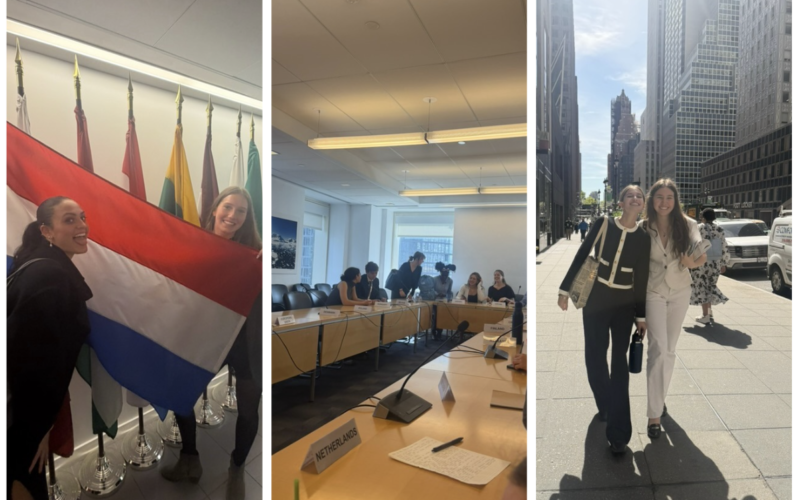
On April 28, a group of Grace juniors and seniors spent an hour being European diplomats. The two sections of Mr. Klebnikov’s Post-War Europe and the Birth of the European Union visited the European Union mission to the United Nations in Midtown Manhattan to meet with representatives from the EU mission to the UN. Students asked questions about the possibility of the EU moving away from American military reliance, the ethics of drone warfare, EU aid to the Gaza Strip, and the future of European security in an increasingly unstable world. The conversation gave students a rare opportunity to discuss current international issues directly with diplomats working at the center of global politics. For many students, the experience reflected the type of discussions they had been having all semester in class. Adrien K. ‘26 described the visit as a “great way to cap off my senior year,” adding that it “so perfectly paralleled Tony Judt’s book that we read (Postwar: A History of Europe Since 1945).”
Similarly, Jack C. ‘26 called the visit a rewarding experience. He explained that “Mr. Klebnikov has taught us how to think critically and ask challenging questions,” something he felt students were able to apply directly during their discussion with the diplomats. Jack asked questions “regarding the hypocrisies of the European Union,” and appreciated that “in their responses, they were very self-critical and open to those questions without deflecting.”
On the trip, students met with Ewout Stoefs and Amelie Lohmann. Stoefs is the First Secretary at the EU Delegation to the UN, and he represents the Ambassador when needed. Lohmann, as the Senior Humanitarian Officer at the EU Delegation to the UN, focuses primarily on humanitarian crises in Asia and Africa.
One major topic of discussion centered on the future of the relationship between the United States and Europe. Responding to concerns about growing political divisions and shifts to the right in American politics, Lohmann explained that “it all comes down to history,” arguing that the deep historical ties between the United States and Europe are too significant to be abandoned because of an administration change. At the same time, she acknowledged that Europe increasingly recognizes that “Europe has to be standing alone on an international stage,” though she emphasized that this process is “more incremental than immediate.”
Students also raised concerns about Russia’s role in European security. The diplomats discussed growing concerns of drone attacks and anonymous fly-overs by drones, particularly in the Baltics, where the insecurity of Russian involvement remains high. They noted that European defense ministries are increasing military budgets in response to these threats. However, the conversation also highlighted lingering anxieties about Germany rebuilding a larger military presence in Europe. When students asked more specific questions regarding military spending and investment, the diplomats avoided directly answering.
The possibility of future cooperation between Russia and Europe was also discussed. Stoefs expressed cautious optimism that future cooperation between Russia and Europe could eventually be possible despite current tensions, emphasizing their shared border. “You can change the government,” he said, “but not the geographical location.”
Students also raised questions surrounding the war in Gaza and genocide in the Middle East; the diplomats often redirected. Lohmann pointed out that countries such as Ireland and Spain have supported humanitarian efforts towards Gaza. A student challenged the diplomats on Europe’s broader responsibility in the conflict, pointing out that the EU is Israel’s single-largest trading partner. Stoef said this relationship gives the EU leverage, but has been disappointed by the extent to which they’ve used this leverage.
This tense exchange showed how Mr. Klebnikov’s instruction has taught Grace students how to ask, rather than avoid, the harder questions. During Klebnikov’s time at Grace, his classes have often been praised for their relevance. Last semester, The New Czar in the Kremlin: Putin’s Russia connected the fall of the Soviet Union and Cold War era politics to the modern war in Ukraine, showing students how history continues to shape today’s global conflicts. Students appreciate his classes for their ability to connect the past to the present, making the classroom feel connected to the real world.
This semester, Postwar Europe continues that approach, blending the continent’s reconstruction after World War II with current debates about the United States’ role in Europe. For example, in class, parallels are drawn between the Marshall Plan and Trump’s “Donroe” Doctrine. Discussions have ranged from the devastation of postwar Europe to whether or not Europe should increase its nuclear capabilities. Through these discussions, Klebnikov’s class helps ignite students’ passion for politics and global affairs.
Students consistently describe his classes as both demanding and relevant. Micah W. ‘26 said, perhaps hyperbolically, that “I have learned more from a Klebnikov class in one single semester than I will in my entire high school and college experience combined.” Reflecting on Postwar Europe, he noted that the class examines “how the fault lines of Europe were drawn after WWII, and we’re seeing the implications of that today,” particularly through discussions of the Marshall Plan and the changing role of the United States.
Micah also recalled a recent class discussion centered around speeches delivered by Vice President JD Vance and Secretary of State Marco Rubio at the Munich Security Conference. “We were discussing whether or not we’re witnessing the destruction of the West as we know it.” Conversations like this demonstrate how Klebnikov’s classes encourage students to actively engage with contemporary political developments and their consequences.
Emma A. ‘26 similarly described Klebnikov’s courses as transformative. “I took Mr. Klebnikov for two semesters junior year, and he was a whole different kind of teacher than I’ve ever had before,” she said. According to Emma, one of the defining strengths of the course is how Klebnikov “instills the idea that history repeats itself.”
The visit to the European Union mission reflected the larger goal of Klebnikov’s classes: pushing students to see history as something actively shaping the modern world. By connecting postwar Europe to contemporary debates over global power, the course forces students to think about the governments and leaders shaping their future.
Antonia A. ‘27 is a staff writer for The Grace Gazette. Zarina M. ‘26 is a senior columnist for The Grace Gazette.