
From Bowery Boys to Bourgeois: Who and What will Occupy St. Marks Next?
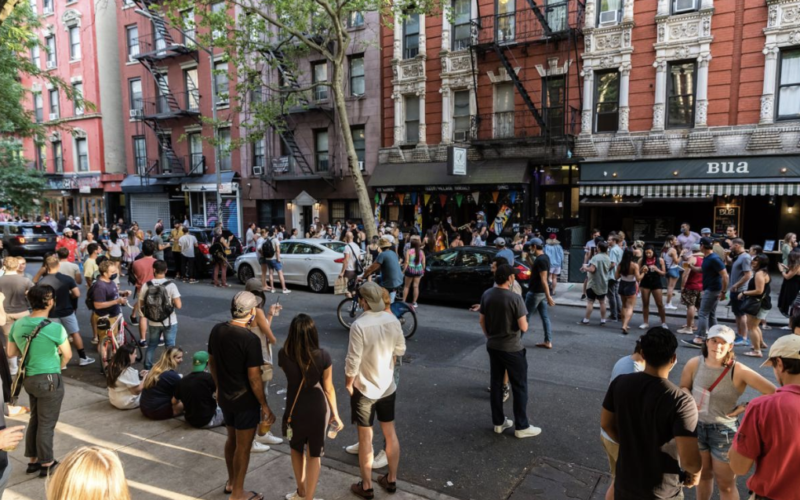
Across Cooper Square from Grace Church School lies one of the most iconic streets in New York City. On St. Mark’s Place, multi-generational punky shops sit next to new sensationalized social media food destinations. On one half block, you can get noodles, tacos, coffee and bubble tea, chocolate and candy, pizza, bagels, soup dumplings, sushi, burgers, and more. Not to mention karaoke, yoga, book stores spilling onto sidewalks, vinyl shops, Japanese beauty outlets where Grace students can get their hands on the newest Sony Angels, clothing—from vintage to new, lingerie and piercings to shirts, movie theaters, crystal shops, and psychics offering $10 palm reading specials. St Mark’s Place is only four blocks long, but it feels like a bustling city within an already bustling city. Here, the new and the old coexist side by side. And once again, the new is swallowing the old.


The shop owners who have been there for years are seeing the change. The entrepreneurs opening new stores are bringing the change. The change is so rapid that Grace students have seen it happen within the small window of their high school years. Notably, Mr. Kim died, Hani’s opened, and, most recently, an international makeup mega chain is opening an outpost opposite the famous St. Marks Hotel. The street, once home to counterculture, is now welcoming a Sephora. This arrival is the first change in St. Mark’s that has outraged Grace students.
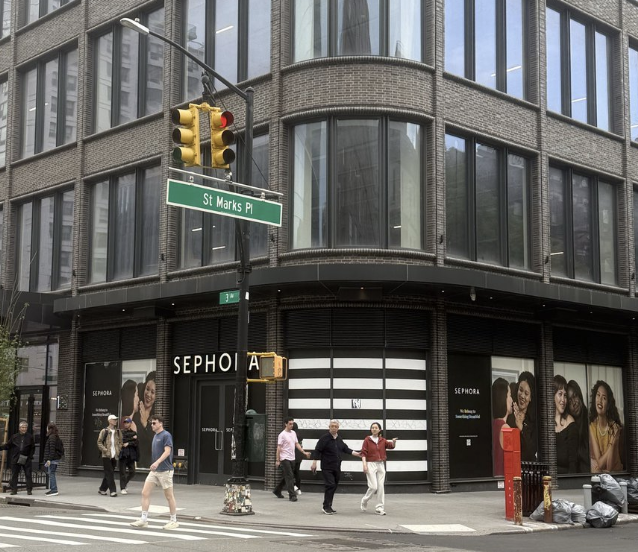
On a Nan Xiang soup dumpling run, Sheriff G. ‘27 saw the Sephora for the first time and said “What, they’re opening a Sephora here? That’s lowkey so weird.” Other students have commented that it’s a step too far.
Nonetheless, the street is no stranger to change. Every century, St. Mark’s has morphed its identity along with demographic shifts. Gentrification began in the 1980s and has “accelerated” ever since, making the street almost unrecognizable to longtime St. Mark’s patrons.
The 19th century was the age of tenements on St. Mark’s. By the mid 20th century, the street was the embodiment of Lower East Side counterculture: Abbie Hoffman, Andy Warhol, Lenny Bruce, Lou Reed, W.H. Auden, Sam Shepard, and the Beastie Boys all frequented the infamous street.
Now, as the 21st century progresses, St. Mark’s has continued to evolve. However, these recent changes worry locals: “It’s not good,” says an employee at Funkytown, a piercing store that has existed for years.


High-end shops have taken up residence on the block once known for its gritty drug culture, and now young yuppies drink aperol spritzes outside and discuss the SpaceX IPO. Naturally, St Mark’s is only becoming more expensive. According to the New York Times, “buying a one-bedroom on the block now costs more than $1 million, and rent for one hovers near $4,000 a month.” The food, once dollar slices, has been replaced by restaurants serving $18 avocado toast.
Many argue that these changes are good; they’ve brought a whole new generation to the street, keeping it alive and vibrant. The owner of a new Vietnamese sandwich shop, Joju says, “St. Mark’s is a very happening place.” Why not open a business here?
On a recent visit to upscale Cafe Maude, the energy was palpable. We talked to the hostess, who underplayed the historical significance of St. Mark’s and beamed about everything that is Cafe Maud today: a restaurant, a brunch spot, and a partial nightclub. The hostess has been working there for a couple of months and is a recent FIT grad from Long Island. She notes that working in the service industry is hard but worthwhile, because she meets a ton of cool people.
More remarkable were the almost comic archetypes of people whom we observed at Café Maud and in the surrounding streets. Trendy clothes and clothes that were trying hard not to be trendy. Scooters and bikes whizzing past. Keys on belt loops with carabiners. The whole nine yards.


Our waiter, a tall Irish 20-something with a thick accent, has retired his Dubliner status to pursue an acting career in New York. Upon being asked, “Have we seen you in anything?” he laughed in our faces. Upon being asked about his views on Saint Mark’s, he said, “Yeah, pretty cool. Dunno, the people here are cool.”
At the table next to us sat classic NYC transplants: a girl in an Alo workout set with a sweatshirt draped over her shoulders and a dalmation named Tokyo secured to her chair with a red leash; a 30-something in jeans and a t-shirt and a baseball cap; a 20-something (or perhaps a well-preserved 30-something) with salon-fresh curls and a white sweater. Everyone but the 30-something in the white T-shirt was engaging in lively discourse about their various creative fields. Zarina ended up playing with the Dalmatian, and we asked them about St. Mark’s. The group echoed the Dalmatian owner’s thoughts: “Some parts are a little ratch, but I like places like these.”
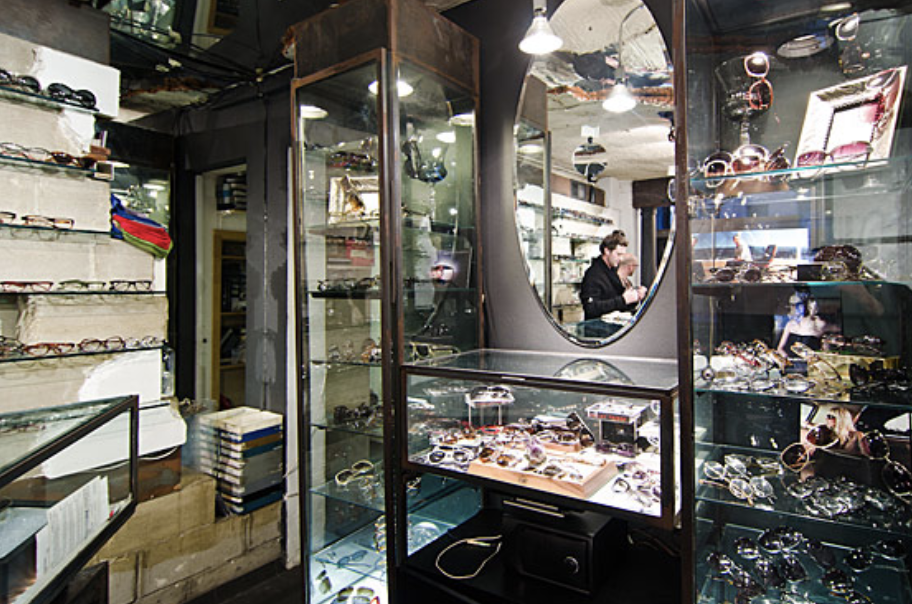
When asked about the changes, he doesn’t feign outrage or nostalgia. He remembers the old while being confronted with the new. The punky grunge kids who used to visit his store have been replaced by Patagonia-vest bros. Gentrification slowly crept in, and the street began to take on a different form. A GAP moved in. Anthony describes the panic at its opening as nearing hysterical. But then it closed, and the counterculture once again felt protected.
Now, Sephora is about to open its doors. Many panic that St. Mark’s isn’t what it used to be, but Anthony observes and thinks it’s just a blip in history; St. Mark’s will always be a home for punks and misfits.
This is the part where you have to make a decision. You, as a Grace student who crosses the street twice a day, who maybe stops for a bubble tea, or cuts through it on the way home without really looking up, have a role in the future of St. Mark’s. Are you a witness to what St. Mark’s is becoming? Or are you part of its transformation into something unrecognizable?
Serena H., the author, is the Editor-in-Chief of the Grace Gazette. Zarina M., the other author, is a senior columnist.