
The Cost of Sleep: A Price That is Steep
As the 2026 school year officially comes to an end, finals week arrived sooner than many of us anticipated, as it often does. Students have crammed for exams with late-night study sessions and early mornings in the PQR. Despite being sleep-deprived, students continue to push through, doing their best to balance extracurriculars, schoolwork, social lives, and family obligations.
Summer being right around the corner, we hope students will take this opportunity to give themselves a break from their triple-shot espressos and hit the snooze button on their alarms. Looking ahead to the fall and students’ future careers and journeys, it is crucial to emphasize the importance of sleep and the significant consequences of sleep deprivation.
“You can sleep when you die,” some people might tell you, but as we often overlook, sleep is a key component of both our physical and mental well-being. Among adolescents, sleep is especially crucial because our brains and bodies are still developing. The Cleveland Clinic recommends that teenagers ages 13-18 get 8-10 hours of sleep nightly to ensure their bodies can perform at their full potential.
Not only has adequate sleep been shown to repair our immune systems and improve our attention span and memory, but it can also enhance our overall health and quality of life. Sleep deprivation, on the other hand, can make one more susceptible to illness, lead to frequent bodily aches, increase appetite, and make it hard to concentrate, whether during a conversation with a friend or in the midst of a chemistry final (“How Sleep Affects Your Health”).
When asked how many hours of sleep students need to feel their best and most productive, over one-half reported needing at least 8 hours nightly. The majority of the student body, however, is not reaching this goal; only around 1 in 10 (8%) students are getting the recommended 8-10 hours of sleep nightly, with over a third (35%) getting only 6-7 hours.
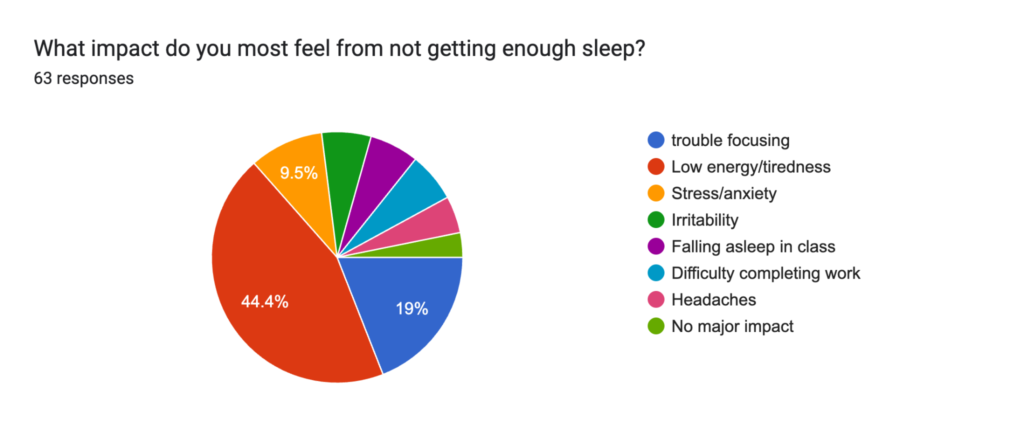
As a result, when given time to reflect, it is evident that this lack of sleep has major consequences: under 3 percent of the student body report no significant impact, while the majority report low energy levels, higher stress and anxiety levels, and trouble focusing.
Mark S. ‘28, for instance, spoke about his goal of sleeping 9 hours each night, saying he would be able to focus much better and devote more energy to his classes, peers, family, and teachers throughout the day without being burnt out by second period.
When interviewed, Nora G. ’28 stated that during basketball season, she often did not get home until 8:30 pm and could not start her work until 10 pm, which led to her having a 1:00 am bedtime and still having to wake up bright and early at 7 am each morning to get to school.
Some people may say that having this 6-hour sleep schedule is normal and not a big deal; however, many studies, including one from Stanford Medicine, show that it is, in fact, a “serious threat to [their] health, safety, and academic success”. Teenagers who consistently fail to obtain the recommended 8-10 hours of sleep nightly have been proven to be most prone to having poor grades, as well as other mental health challenges.
Failing to understand the consequences of their sleep deprivation, many students claim this lifestyle is sustainable, saying that they “catch up on sleep during the weekends” as Aran ‘27 noted; however, according to Harvard Health, “Researchers found that subjects who cut their sleep down by five hours during the week, but made up for it on the weekend with extra sleep, still paid a cost”.
Although it may seem impossible for many students, prioritizing sleep through careful planning and organization can significantly improve their energy levels, focus, and overall well-being. There is no doubt that students who get adequate sleep will be able to tackle their days without relying on their constant caffeine intake, blasting music, and sugar overload just to keep their eyes open.
I encourage you all to think: next time you decide to pull that all-nighter or chug your Celsius before bed, ask yourself: Is this helping you achieve your goals, or is it actually setting back both your future ambitions and long-term health? If this was not convincing, I would like to leave you all to consider this finding from a study conducted at Oregon Health & Science University: “Getting a good night’s sleep will improve how you feel but also how long you live.”
Madison G. ‘27 is a Staff Writer for the Grace Gazette.