
What Does America Mean To Grace?
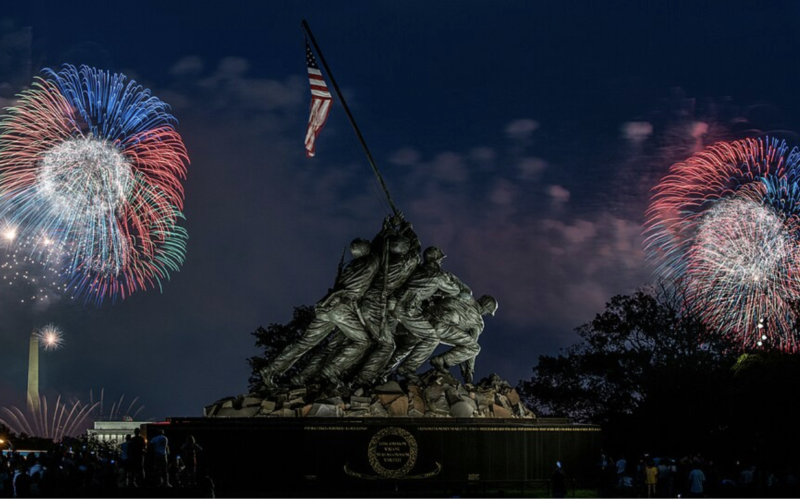
Fireworks at the US Marine Corps Memorial in Washington D.C. on July 4, 2021/Source: Wikipedia Commons
For most Americans, July 4th is about barbecue, beer, and fireworks. But this year lands differently. This summer, the country will celebrate its 250th birthday. For Americans and for the Grace community, the anniversary offers an opportunity to grapple with what it actually means to be American.
From small towns to New York City, from local parades to a UFC fight at the White House, Americans are going all-in for our big birthday. However, America will turn 250 amid rampant political polarization. Recent polls have revealed record-low levels of national pride and patriotism among Gen Z adults.
To commemorate the semiquincentennial, the NYU Grey Art Museum, down the block from Grace, is exhibiting a 1776 copy of the Declaration of Independence. The exhibit focuses on the list of grievances that form the document’s framework, including limitations on immigration, domestic deployments of soldiers, and restrictions on trade. In America’s contemporary fractured moment, Thomas Jefferson’s founding ideals remind us of the country’s current challenges.
STUDENT VOICES
For many Grace students, concerns surrounding the Trump Administration’s aggressive deportation agenda stand out prominently as they consider what it means to be American in 2026.
“I’m not really that proud of being an American,” said Phoebe P. ‘29, citing the policies of the Trump Administration and ICE’s nationwide crackdown on illegal immigration.
“I think [being an American] means recognizing that America is a convergence of people from many different cultures,” said Apollo K. ‘26. “America is a country built on immigrants. The workforce of America has historically been immigrants.”
For Lucy W.R. ‘27, “approaching 250 years, we’ve just seen so many American dreams crushed recently by the current administration.” She explained, “I am sort of disillusioned by the idea of the work in America leading to this success that has always been promised, but at the same time, I can’t help but feel hope about the pushback against the demonization of immigrants.”
Other Grace students pointed to dueling narratives of American identity, a through line that has defined U.S. history, emerging as a potent political wedge on the American right in recent years. At an event in the summer of 2025, Vice President Vance said, “I think the people whose ancestors fought in the Civil War have a hell of a lot more claim over America than the people who say they don’t belong.”
“I think there are two ideas of Americans,” said Eduardo P. ‘26, Grace’s former student body leader. He pointed to two groups: one that believes that America is restricted to the ideas during the founding era, while the other believes in a more inclusive and open society.
As the United States approaches its 250th anniversary, the debate over the narrative of a nation of inclusive ideals or restrictive nationalism has also factored into some students’ conceptions of their American identity.
For Anika V. ‘27, American identity is fundamentally inclusive. “Being an American [means] being accepting of all identities,” she said. “Specifically because we lack an identity that’s intrinsic to us other than nationality.”
FACULTY PERSPECTIVE
Language Department Chair Dr. Alice Polanski, a naturalized American citizen and French national, described what America means to her: “If you are an American, you have to stand up for the Constitution, the separation of powers. You have to embrace your history.”
Reflecting on the meaning of America in our 250th year, history teacher Mr. Alex Dillon pointed to the second verse of the patriotic song “America the Beautiful”: “God mend thine every flaw, Confirm thy soul in self-control, Thy liberty in law!”
“Life in a free society is only livable when people act with self-restraint and compassion for their neighbors,” Mr. Dillon explained. “Freedom must be tempered by the rule of law.”
Mr. Okpalugo expressed the hope he felt for America during the recent Artemis space mission, despite the current moment of national crisis. “I was surprised by how emotional I was,” he said. “It made me excited about what’s special about this country. Look at these incredibly smart, modest individuals. The diversity of the squad. The pilot being African American.”
A nation forged by revolutionary ideas of liberty, we still struggle to realize our centuries-old ideals today. Our 250th birthday this summer gives all of us a chance to find our role in making America’s founding principles true. On July 4th, in between beach barbecues and family gatherings, Grace students and faculty should pause for a moment and think about where America has been and where we are going.
Wilson Urist, the author, is a staff writer for The Grace Gazette. He is the founder and leader of the Grace High School Democrats.