

The Visit of Gabby Giffords: What did we need to hear?
After two standing ovations, two introductory speeches, and one untimely fire alarm, the members of the Grace community held high expectations for modern American hero Gabby Giffords and her husband, Mark Kelly. Perhaps no one had greater expectations than me. In preparation for this very article, I watched interviews and read through lists of legislation that I had hoped would allow me to analyze their remarks at Grace in relation to their standing policies.
Our school, although seemingly normal to the rush of touring families herded through our halls, is still reeling from the death of a community member. I am still unable to cross Cooper Square without physical hesitation and momentary mental lapse. I think many of us anticipated the visit of Captain Kelly and Senator Giffords to somehow resolve our anger and grief, helping us to redirect it towards a cause that would prevent another community from enduring what we have struggled with since that fateful Wednesday morning.
Mr. Kelly, standing in front of a packed audience in the MPR, gave a quick thanks to Ms. Chaloner and made a joke about the fire alarm that went off the first time he and Senator Giffords came to Grace only a month before. As he began his speech, I was knocked off guard by what I found to be relative insensitivity towards a “pretty serious event” that our community had gone through, seemingly unaware of the direct connection that the tragedy had with our community.
Assuring myself that this was simply a lapse in judgement due in part to unawareness of the details of this “event,” I brushed off his rather glib synopsis until he approached the topic of the Sandy Hook Elementary School shooting with an similarly casual tone. He named it as the catalyst for foundation of their organization against gun violence, Giffords: “Does everybody remember that one? Twenty dead kindergarteners and first graders.” I still presumed myself to be imagining the unfortunately off-hand tone in which he brought up the mass shooting that, as I remember, brought gun violence to the focus of the general American public. For me, the shooting was framed as my eleven-year-old self stepped over Daily News titles reading “Fallen Angels” and “Shame on U.S.” for mornings on end.
As Capt. Kelly continued beyond this reference, I noticed a few heads uneasily turn to their neighboring chair, reaffirming 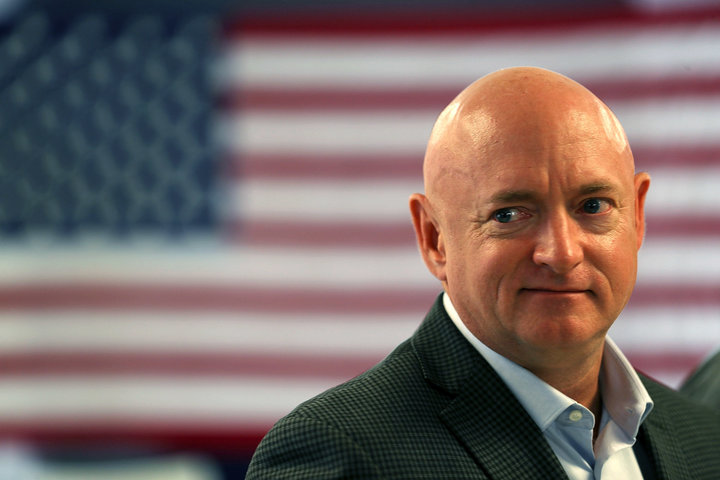 my initial thought that there seemed to be a lack of respect for the grief surrounding our community and our country when he brought up the shooting at Sandy Hook. Maybe, I thought, the familiarity that he uses when discussing these issues could be accounted to his own personal experience with gun related tragedies: the shooting of his wife, Sen. Giffords, in 2011, or his experience in the military. Or maybe he had simply become so accustomed to making these speeches that he had become less sensitive to the impact that the mention of these incidents have on a crowd.
However, as he moved on to introduce the body of his speech, I tried to ignore my previous misgivings, preparing myself for what he promised to be an explanation of “why these things happen in our country today” and serve to “remind us all that it’s not normal.” He highlighted some shocking and detailed statistics that demonstrated the singularity of the horrifying phenomenon of gun violence that America faces in comparison to other industrialized countries. Beyond the impact that these statistics themselves made on the audience, the fluency in which he railed them off was impressive. In retrospect, that should have been my first warning that the perspective-altering speech that I had so eagerly awaited was not necessarily the one I would hear that afternoon. In fact, the rehearsed and predictable nature of these statistics set the general tone for the rest of his address.
Capt. Kelley moved on to define the sources of our country’s problem: “Political influence, the power of money, and the influence of an organization that we call the Gun Lobby.” He clearly defined each source in greater detail, including short anecdotes about our own city and its relative safety in terms of these issues. It was at this point, about a quarter of the way through his speech, that I recognized what irked me about the structure of his speech; the construction was altogether too organized. I most liken it to an analytical essay that a Grace student might write in any history or literature class. He began by clearly stating his main idea and immediately followed with three overarching themes that he would break down for us in the rest of his argument. While easy to follow and a notably impressive feat, it forced me to realize the obvious truth that the lines of facts and policy that he was outlining before an eager audience were inorganic and followed the same formula he had no doubt used when addressing countless audiences before. All of this stood in contrast to the more personal address to Grace, a community that has lost so much these past few months, that I had expected to hear.
After almost exactly nine minutes, he passed the microphone to Sen. Giffords. A side effect of her injuries, aphasia, prevents Giffords from being able to communicate fully, although her cognitive abilities remain generally unaffected. 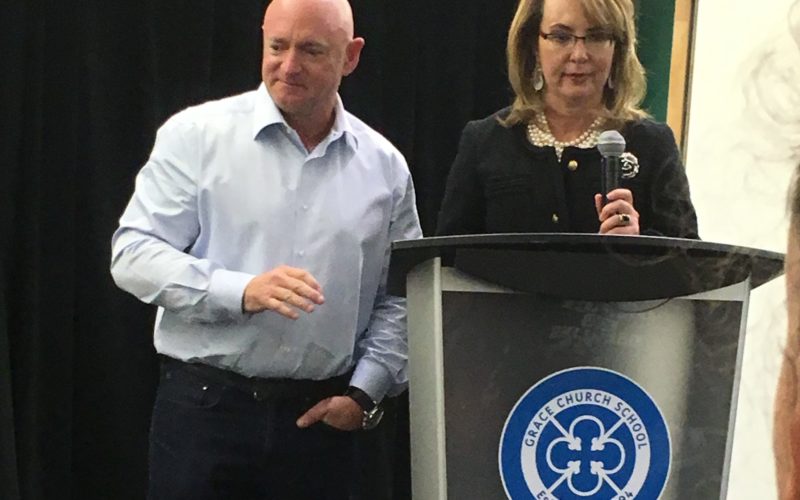 This means that while she is able to formulate and organize her thoughts completely in her head, she encounters an unimaginably frustrating block when attempting to voice those thoughts. In her brief remarks to our community, she encouraged us to get in contact with our representatives and to become leaders ourselves even within our community as well as referenced her continued rehabilitation efforts. Although her words were generally superficial in nature, the severity of her circumstances was apparent and perhaps the most meaningful part of the whole hour. Sen. Giffords’ remarks were a reminder of the long-lasting gravity and impact that gun violence leaves, even years after a shooting.
If Capt. Kelly or Sen. Giffords had approached their speech with a heavier tone, I doubt I would feel as disappointed. Although the policies that they discussed are undeniably important, the casual and practiced form that their speech took delivered their message ineffectually. In fact, the tone that I expected was the one used in a speech delivered immediately after the Las Vegas shooting in October: one filled with frustration, grief, and anger towards the “tragedy” affecting that “dark day.” It is also possible that they assumed our community had healed more than it has or that their intention was not to heal at all; only to present us with facts and leave us to interpret what they mean to our community.
Overall, I think that our community deserved something different than what we received. Looking back on that afternoon, I don’t believe that my expectations were set too high: Grace needed hope, and their words only brushed the surface of a topic that our community in particular needs to understand. Although a template of general topics about gun control covers incredibly important issues that schools need to address, our community continues to grapple with loss and grief that were simply not satisfied or abated by the words of Capt. Kelly and Sen. Giffords. My confidence in their ability to give our community hope was altogether premature and mislead.