
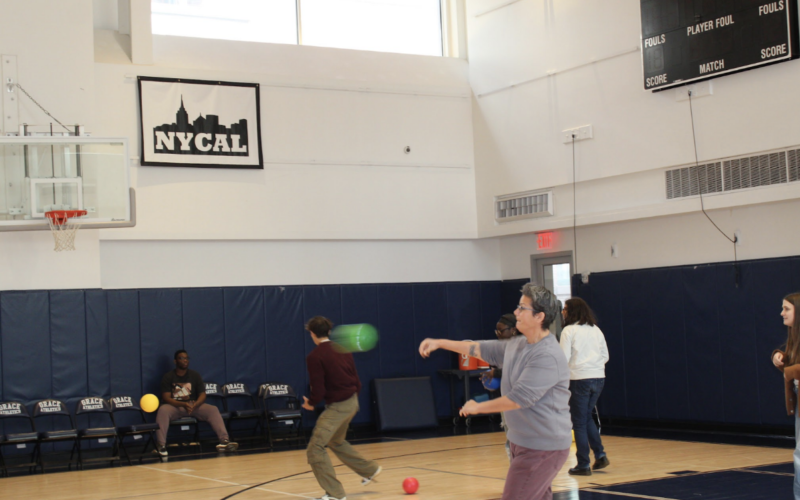
School Actually Can Be Fun
Media Provided by Brian Reilly. Pictured: Class of 2025 playing Dodgeball.
Everybody knows that the learning aspect of school is about rigorous, intensive, disciplined studying, and the fun aspect of school is hanging out with friends between classes, playing board games and sports during lunch, and the quintessential “bathroom breaks…”
There is something rebellious and joyfully youthful about not taking school seriously and focusing on the social part. There is something even more rebellious about students seeing this perspective as only half the story.
One specific example of the benefits of a rowdy and expressive culture is the dance traditions that follow community meetings. Senior students Felix W. ‘26 and Ahilya E. ‘26 “look forward to Wednesdays just to see the joy and freedom of our classmates, it makes us feel excited to go back to class.” Similarly, Head of Admissions Dana Foote believes that “happy learners are better learners,” and Grace prides itself in generating positivity and excitement surrounding a rigorous education.
Student Body President Eduardo P. ‘26 also notes the constant collaborative learning opportunities, group project discussions, field trips, and numerous types of assemblies at Grace that enhance student engagement and learning.
Assistant head of High School, Mr. James, commented that part of Grace’s active mission is to fill its halls with students “too broad to fit into one category,” students who are excited about the virtues of ethical and intellectual excellence, students who are willing to “learn together, fail together, grow together.”
Analogously, the concept of play and group learning is vital to the development of newborn puppies and other animals. The Animal Hospital of Clemmons states that engaging in play “builds confidence, teaches motor skills, improves impulse control, and strengthens neurological connections.” In the same way, adolescents and teenagers receive the same benefits; the multilayered network of interactions between social and educational environments serves as a bonding agent for positive, holistic learning (The Harvard Gazette).
At the very least, the Ancient Greek word σχολή (/skho-lay/) is a noun describing productive leisure-time. It evokes a quiet, restful, almost meditative-like ecosystem where students enter with the intent to harness knowledge and contemplate self-cultivation. The focus was a separation from intensive physical labor and daily chores, and a retreat into the mind and body. This word and concept have evolved into the modern word School1 /sko͞ol/, and for the better, Grace Church School does not match its original meaning. The root of the Greek word comes from Proto-Hellenic *skʰolā́, meaning “holding back”; however, it is imperative for students to do the opposite: buy in, do their part to stay engaged, and embrace rambunctious, excited self-expression, which will manifest as an irrefutable, genuine excitement for learning.
Wesley T. ’26, the author, is a staff writer for The Grace Gazette.