
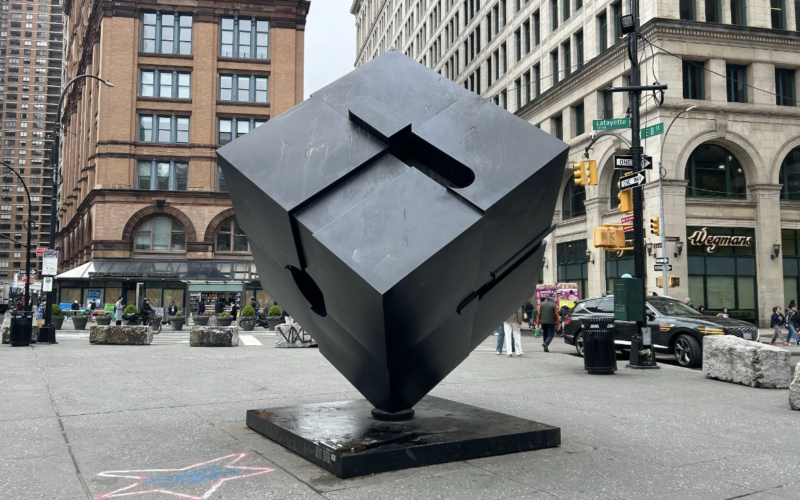
“Remember the Alamo!”
The Astor Place Cube has a surprising history.
Media Provided by Ben A. ’26
So what’s the deal with the big black cube in the middle of Astor Place? Grace legend has it that there’s a man who secretly lives inside. Until proven otherwise, this legend persists.
The people who were basking in the warm, sunny weather by the cube last week had a variety of takes on the cube. While some were excited by it and had plenty to say, others barely noticed it at all.
Marriott, a photographer visiting from North Carolina on a photo project, noted that choosing the cube as a backdrop for her lunch was not a conscious decision, but that she had come to enjoy the view. “I like that it provides contrast, form, and interference in the middle of this beautiful, organic central area,” she said, gesturing at the cube. She even remarked that she had snapped a photo of Wilson U. ‘27, another staff writer for the Gazette, and I, trying to push it around before we had approached her.
Silas, a senior at NYU, remarked that he was very excited about the cube when he first came to New York from his high school in Seattle. “It’s great to have something people can bond over,” he said. He even considers the club as part of his “flirting strategy,” or his “game,” rather, as he likes to bring girls mid-date to the cube to push around together.
Grace, another college-age interviewee, felt differently about the cube. “I had never even thought about it until now,” she remarked. After a moment or two of examination, she admitted that she felt like it was “a little abrupt,” and that she wished it was either concrete or more colorful.
According to the official website of sculptor Tony Rosenthal, the cube was created by Rosenthal and installed in 1967 at Astor Place. Originally intended to be a temporary exhibition, it was so beloved that New York City residents who frequented the area petitioned for it to stay. Rosenthal named his structure “The Alamo,” after the historic fortress in Texas and site of the Battle of the Alamo in 1836. The people in Texas at the time lost the battle, but nonetheless, “Remember the Alamo!” later served as a battle cry that reminded Texas soldiers what they had lost. Rosenthal never explicitly stated why he chose to name the cube after the Alamo, but it is plausible that he meant to hint at the unifying, communal nature of the piece.
Speaking on the cube’s size, Rosenthal said that “If it had been monumental in scale, while it might have looked better in general for the surrounding area, at the same time it would have lost that human scale…people feel friendly. It’s a friendly object.”
While little discussed in day-to-day life at Grace, “The Alamo” remains a friendly, familiar presence in our neighborhood. It’s possible that we, as a community, underappreciate a work of art that was so heavily campaigned for nearly 60 years ago.
Next time you walk by it, give it a spin.
Ben A. ’26, the author, is a staff writer for The Grace Gazette.