
Religious Inclusivity at Grace
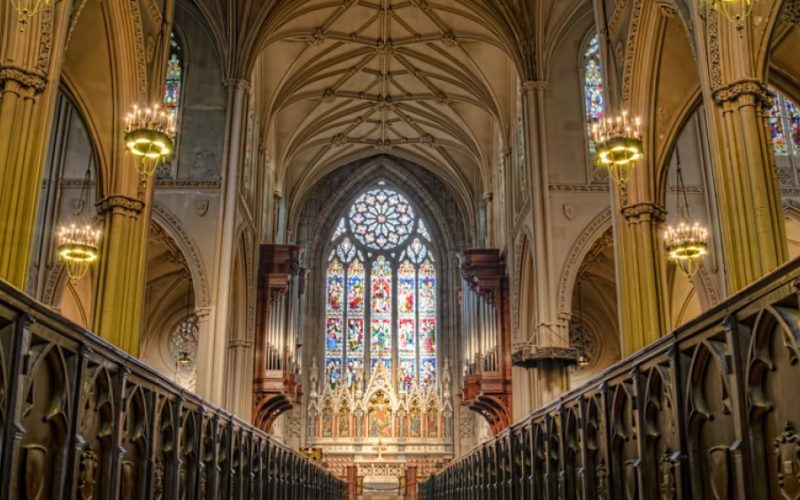
Grace Church School students regularly attend bi-weekly chapel meetings where biblical texts are read and celebrated. Students have shared their affiliation with a God or religion in chapel meetings before, yet the vast majority of students and faculty are Christians and focus solely on that belief system, so akin to Grace’s Episcopalian values. Recently, students who identify with religions other than Christianity have expressed concern that Grace is somewhat exclusive in regard to other religions. According to the school’s website, “We are an intentionally inclusive community where reverence for the dignity of each individual informs all aspects of school life. The Episcopal school tradition recognizes the unique, intrinsic worth of every human being, bestowed upon each by a loving God. In this spirit, we welcome, openly and with warmth, families of all faiths and no faith at all.”
Rania Challita ‘22 affirmed that chapel can feel overwhelming for a non-Christian student: “Grace says we are nondenominational, however, at chapel, we seem to only read from the Bible and it would be nice if we could also read from other religious texts too.” Rania’s family are Lebanese Catholics, but she does not follow Catholicism closely. She claims she doesn’t mind the Christian rituals that occur in chapel, however, a student who practices an alternate religion reacted differently.
When asked about her experience as a Jewish student at Grace Church, Charlotte Merrin ‘22 feels that, “Judaism is not talked about as much as I would like at Grace.” Despite the fact that there is quite a large Jewish population at Grace, many students agreed that the current anti-semetic behavior around the world isn’t talked about enough within the student body.
Mariema Tall shared her experience of being a Muslim at Grace: “There is definitely less representation for Muslims in the student body. I know there is a Jewish affinity group and the school is an Episcopalian organization, yet we don’t talk about things that are happening in the Muslim community.” In addition, Mariema suggested a way to make chapel more inclusive of other religions: “I would appreciate it if we read from the Qu’ran more often, or potentially talked about Muslim holidays in addition to Christian and Jewish holidays.”
Reverend Hummel plays the essential role of religious and spiritual leader at Grace. Rev believes that the school “casts a wide net in the curriculum of philosophy and religion, and we try our best to make sure everyone is represented.” Grace strives to maintain an Episcopalian identity, therefore chapel is necessary because it is an opportunity for everyone to come together as a community. Reverend Hummell believes that over the past 125 years at Grace, chapel has been the best way to foster this sense of community. In the future, it is unclear if reformation will indeed come to Grace in order to assure the inclusion of all students, Christian or otherwise.