
A Chapel for All Faiths
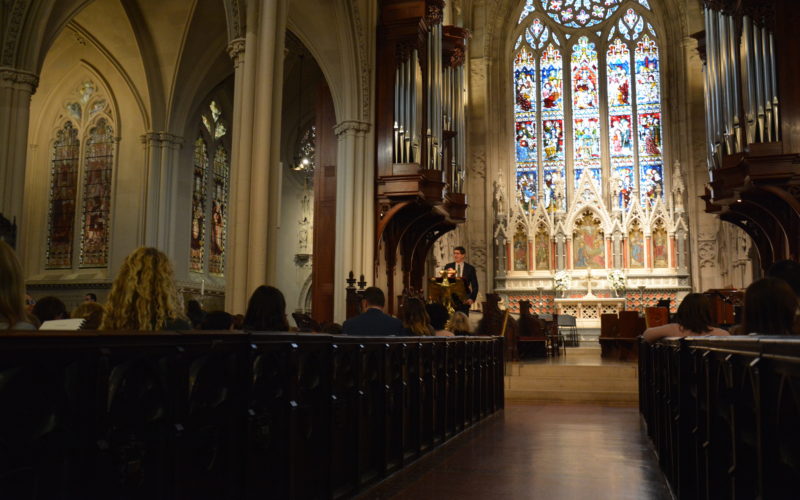
Is it possible that weekly chapel in an Episcopal school can be inclusive of many religions? This question has sparked controversy among students and faculty of differing faiths. According to the Grace Church School website, “Chapel provides a space apart, a still point in the day where all may slow down, reflect, relax, think, feel or pray. It is also the one central gathering place for the entire school community.” However, some non-Christian students have voiced concerns that chapel places a pressure to conform to a certain religious identity, while others do not mind chapel and like the sense of community it offers.
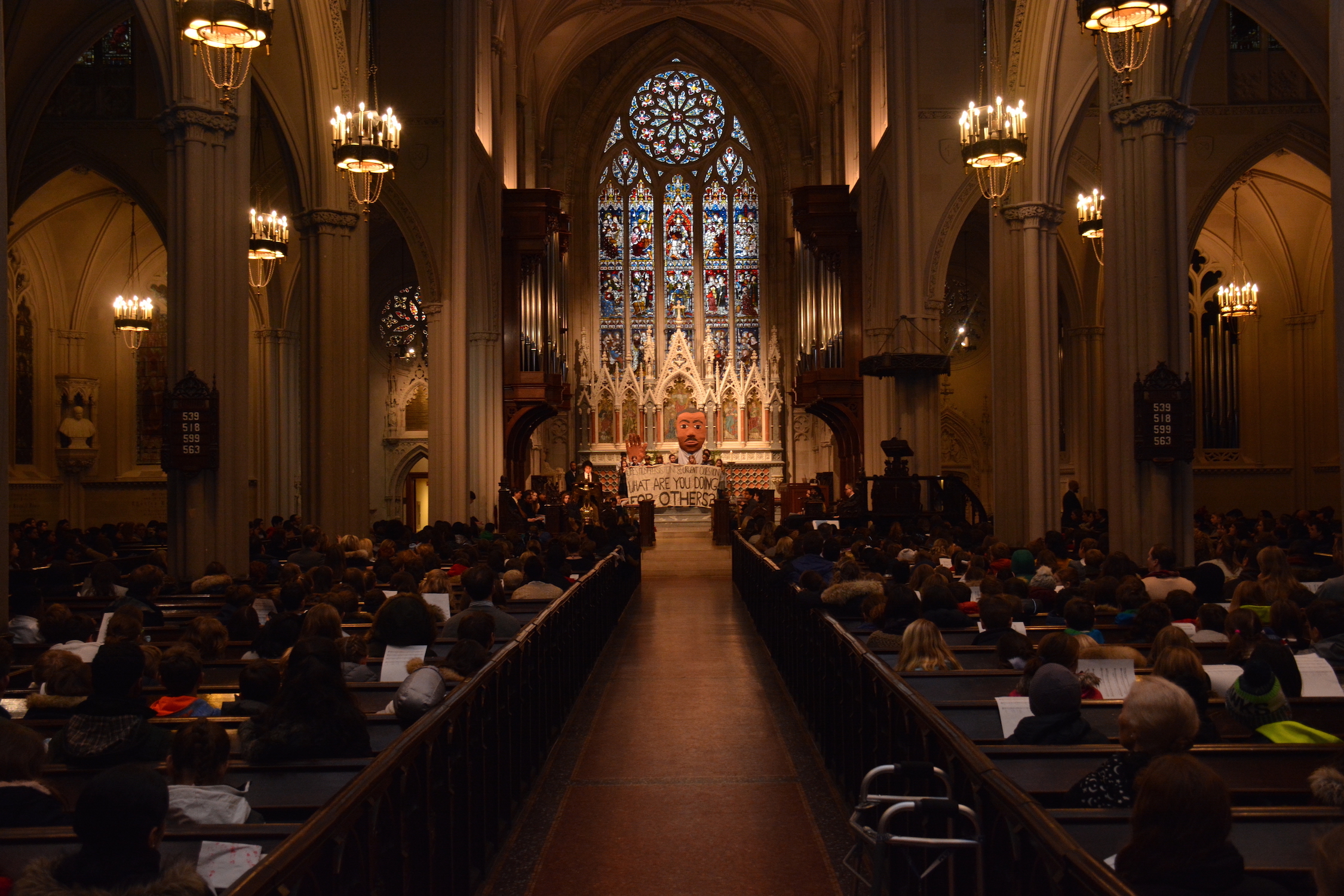 Chapel at Grace has been around for 124 years and is a very important and long-lasting tradition, it is hard to change. Every Thursday morning for forty minutes, students in the High School Division attend a chapel service, led by a chaplain, Reverend Hummell. Chapel signifies different things for students across religious backgrounds. For Michael Abrahams ‘19, chapel does not imply a religious agenda but rather, provides a community building space. Michael said chapel is, “An hour of meditation where we can just sit there and hang out and chill.” Talli Weiss ‘21, in agreement, said, “Chapel to me is more a community thing than a religious one.” Talli, however, believes chapel can be improved by including, “More non-religious aspects or include some prayers from Judaism, Islam, just to be more inclusive.” On the other side, Thea Polsky ‘20 said that the prayer at the end makes her, “Feel overwhelmed.” Charlotte Merrin ‘22 said that when she began at Grace, chapel made her feel different from the predominantly Christian community around her. Charlotte Merrin said, “It was really weird at first. I felt out of place.”
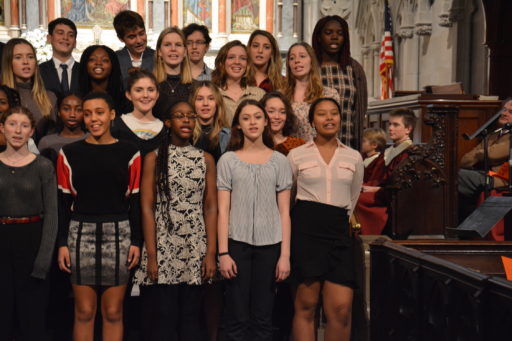
Students find many aspects of chapel that they enjoy. Michael Abrahams said, “I like the speakers that come and speak because they don’t have anything to do with religion, and they are always very good, and it is meaningful what they say. I like when we share personal stories.” Similarly Talli Weiss responded by saying, “I really like the speakers, I think those are really interesting. It’s interesting to hear, especially teachers, give their perspective of topics they don’t usually get to discuss to the whole school.” Mr. Zaretsky, Technology Teacher and Advisor to the Jewish student club Yeladim Shel Chesed, said, another positive aspect was, “Being able to spend a morning with this community.”
When we asked the people we interviewed whether chapel should be optional, opinions diverged. For example Michael Abrahams claimed, “If it was optional during lunch, nobody would go, but if it was optional instead of a lab day class then everyone would go.” In addition, Talli said, “I don’t think it should be optional because I think if it is then no one is gonna go. I think it definitely is a community aspect and yes waking up early is not fun, but I think it is definitely worth it.” Similarly Mr. Zaretsky responded by saying, “I think it’s an important part of the character of our school. This is an Episcopal school with certain guidelines, and chapel is part of that. I would hate to see that change.” On the other hand, Charlotte Merrin said, “I think chapel should be optional, I do not dread or hate going, but it is a little weird for me, and I am guessing for other non-Christians.” Thea Polsky said, “I think if we keep it every other week, then it should be optional, and I think if its just once a month then it’s fine.”
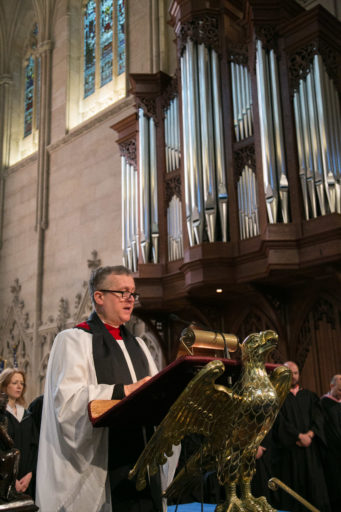
A lot of planning goes into chapel so that it can be an inclusive place for all religions. Reverend Hummell, Grace Chaplain, said about planning chapel, “I take into consideration what is going on either in the school, for example, or within the calender of the school. There might be a major holiday that is going on, there might be something more topical that is happening, so we look at things like Hanukkah, for example, we are looking at Christmas. We also look at more topical things, for example a couple years ago we had that whole Ferguson incident that was going on, a lot of students did a presentation within chapel, during the chapel talk time of what was happening then. Two chapels ago there was the shooting in the synongauge, so there was the remembrance of that and Ms. Lee who we also had a remembrance of the one year anniversary of her death.”
When doing Christmas or holiday chapels, Reverend Hummell said, “It used to be that there was a Christmas pageant that we tied into the school and it was for JK-8th grade and when the high school was added they also included the high school. But last year I actually formed a student vestry, whereby I had certain students that helped arrange the different service. Instead of having a Christmas pageant, which still goes on in the JK-8th grade, we now have a high school holiday chapel so that it is more inclusive of things like Hanukkah and other faith traditions as well, but we also celebrate Christmas. We cast a very wide net. We try to maintain an Episcopal identity.” According to the National Association of Episcopal Schools, “Episcopal schools are created to be communities that honor, celebrate and worship God as the center of life. They are created to be models of God’s love and grace. They are created to serve God in Christ in all persons, regardless of origin, background, ability, or religion.” Being an Episcopal school does not mean that the school is centered around one religion or one belief.
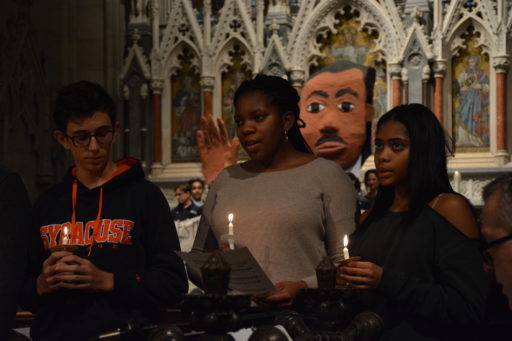
When doing holiday chapels of other faiths such as Judaism, Reverend Hummell said, “We have had remembrances of Rosh Hashanah and Yom Kippur and work with Mr. Zaretsky especially in Yeladim Shel Chesed, so we have them help us a lot with Jewish holidays. We have had atheists preach at the chapel talk, but we still maintain the Episcopal identity. You will always have the hymn from the hymnal, you will always have the Lord’s Prayer, and then you do have readings that are considered from the Old Testament, the hebrew scripture, and the New Testament, the Christian scripture.” Lastly, while considering atheists in chapel, he said, “Chapel attendance is mandatory, but chapel participation is voluntary, so you’ll notice, even when I do the Lord’s prayer I will always say ‘and now if you wish you may join me in saying the Lord’s prayer.’ So it is not forced on someone who doesn’t have that belief. So they actually have the time in Chapel that they can sit, they can meditate, it’s a time for them, but a lot of our chapels I think are really very secular, so they might have something on joy in your life, or anxiety, or black history month, or something that is thematic that isn’t necessarily tied into being overly religious.”
It is clear to see that Grace is a very inclusive and welcoming community of all faiths. Chapel serves different purposes, on one hand, it is a place to participate in a religious service, but on the other it is a place where students or faculty can just meditate and relax. Ultimately, the goal is make room for every person’s chapel experience to be different but to be inclusive of all religions.
This article was written by Lena Arnsten ‘21 and Julie Silverman ‘21
Photos by Mr. Nichols