
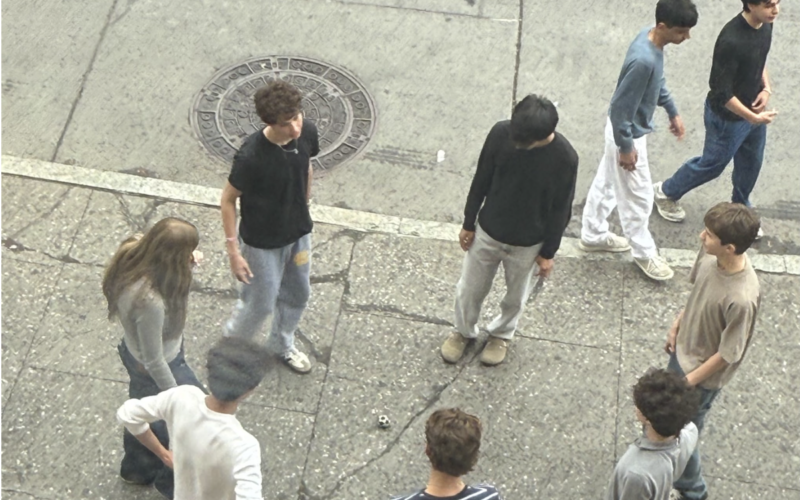
Hacky Sacking: The Newest Trend taking Schools by Storm
Hacky sacking is back, turning empty pavement and school hallways into a space of competition. Once an emblem of 1990s counterculture, the hacky sack has reinserted itself as a modern staple of Grace student life. Propelled by social media attention, viral TikToks, Instagram clips, and the craving for some digital detox in a world dominated by screens, the hacky sack has made a return to campus quads nation-wide.
Contrary to popular belief, hacky sacking is not a new trend. Initially popularized in the 1990s after its introduction in the 70s, the cool squishy took over our parents’ generation. Today, however, the re-appearance of hacky-sacking more broadly reflects the influence of social media on teen lifestyles.
The new hacky sacking trend reflects Gen Z’s nostalgia for the 1990s. Senior Trends Analyst Stephanie Harlow at GWI notes that “over a third of Gen z are nostalgic for the 90s, despite the majority being born in the 00s”. Nostalgia as a trend is pertinent to our generation, and social media platforms alike love nothing more than to fuel it. Seeing things like polaroids, digital cameras, and vintage sportswear as something to desire, Instagram and TikTok feeds sponsor content and advertisements that feel “vintage” or “retro.”
While social media may have contributed to hacky sacking’s resurgence, its appeal is not limited to the “nostalgia” of it, but the game itself.
Students at Grace have expressed significant interest in this new trend. You might have noticed this too. In the corners of commons, groups of 3 to 4 have squishies at their feet, sometimes even nuzzled between shoulders.
Many students say that this appeal stems beyond online attention. Burhanuddin T. ‘27 believes that hacky sacking stands out because of how accessible and social it is. “I think it will last because unlike many fidgets like NeeDohs and stuff that tend to break over time, I feel like a hackysack is more durable and lasts a lot longer,” he explained. “You can do a lot of stuff with it: throw it around, juggle it, squeeze it.”
Burhanuddin also explained that the activity “doesn’t feel very competitive,” instead it feels like “more of a way to socialize and play a fun game with friends than anything else, similar to the way we enjoy Spikeball and similar games.”
Faculty members at Grace too have noticed the trend’s mighty return. Mr. Casey has seen an “uptick” in hacky sacking over the past few weeks and has enjoyed seeing so many students playing and interacting with each other outside of just their computers. “Everyone seems to be having a really great time,” he said. “Laughing at each other, playing with each other and they’re all off their computers, which I think is great.”
In addition to the social aspects of the game, faculty alike elaborated on the technical aspects as well. Coach Sergio Anglade elaborated that hacky sacking presented a great “opportunity to showcase your skills” no matter what sport or athletics background you have. Likewise, Mr. Casey commented that “it takes a lot of work and coordination to do this; it’s a challenge, and I think it’s great that it enables people to use a different part of our brain.”
Now, whether this trend lasts another few months or several years, hacky sacking has already changed Grace and school atmospheres nationwide. In a school environment that remains shaped by screens and social media, a simple, relaxing circle of students kicking around a fabric bag has made a name for itself as one of the newest ways to connect.
Blake H. ‘27, the author, is a staff writer for The Grace Gazette.